Lumière-Matière
Light-Matter Interaction and Lasers
Description: This course presents the fundamental concepts of light–matter interaction using the semiclassical formalism, in which the electronic structure and dynamics of matter are described within quantum mechanics, while the electromagnetic radiation field is treated classically. The course develops the theoretical framework necessary to understand absorption, spontaneous emission, and stimulated emission processes, with particular emphasis on their physical interpretation and quantitative description. These mechanisms are introduced through simple atomic models and form the basis for analyzing optical transitions and energy exchange between light and matter.
On the basis of these fundamental interactions, the course examines the operating principles of lasers (Light Amplification by Stimulated Emission of Radiation). Key elements of laser systems are discussed, including population inversion, optical gain, and resonant cavities. The main dynamical regimes of laser operation are analyzed, ranging from continuous-wave emission to various pulsed regimes. Finally, selected applications of lasers are presented, with particular emphasis on atomic physics applications such as laser-based manipulation of atomic motion, laser cooling, and trapping techniques.
Bibliography:
- Ref. [1] : B.E.A. Saleh, M.C. Teich, Fundamental of Photonics, Wiley (2007)
- Ref. [2] : M. Sargent, M.O. Scully, W.E. Lamb, Laser Physics, CRC Press (2019)
- Ref. [3] : C. Cohen-Tannoudji, J. Dupont-Roc, G. Grynberg, Processus d interaction entre photons et atomes, EDP Science CNRS Edition (2001)
Learning outcomes: AA1: Understanding of transition probabilities and atom–radiation interaction – AA2: In-depth knowledge of the fundamental principles and basic properties of lasers – AA3: Mastery of the elements of statistical optics and their application to laser coherence and linewidth – AA4: Identification and analysis of the various applications of lasers across different scientific and technological fields
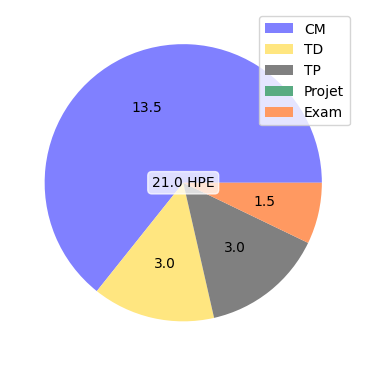
Evaluation methods: Written test, 1h30
Evaluated skills:
- Physical Engineering Design
- Physical Modeling
Course supervisor: Lucas Oliverio
Geode ID: SPM-PHY-012