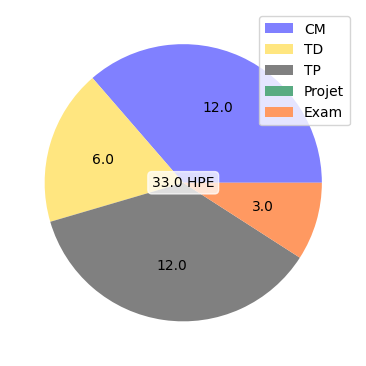
Electronique 2
Electronic : Conception and Integration
Description: The second-year core-course in Electronics aims to deepen the concepts introduced in the first-year course. In particular, it covers the basic building blocks (transistors) used in the design of integrated circuits. An in-depth study of these building blocks makes it possible to understand the imperfections of integrated components, including their frequency limitations, thermal aspects, and power consumption.
Bibliography:
- Ref. [1] : P. Aldebert, Modélisation des composants usuels pour la conception et l’analyse, CentraleSupélec, 01134/01, 2004
- Ref. [2] : G. Tourneur, Introduction à l’électroniqueanalogique, CentraleSupélec, 17189/01, 2017/2018
- Ref. [3] : J. Oksman, J-P Zsylowicz, P. Benabes, G. Seignier, Y. Houzelle, Systèmes logiques et électronique associée, Volumes 1 et 2, CentraleSupélec, 2020/2021.
Learning outcomes: AA1: Understand the concepts of analog and digital electronics: component modeling, biasing, linearization, large-signal analysis, feedback and loop control, impedance matching, synchronous sequential logic, and frequency-domain behavior - AA2: Master the main CAD and simulation tools - AA3: Be able to analyze electronic functions using appropriate models - AA4: Be able to design and size electronic functions while taking into account interfaces between components and with the external environment - AA5: Be able to specify an electronic system and write technical specifications
Evaluation methods: Written test, 1.5h
Evaluated skills:
- Physical Modeling
- Systems Analysis
Course supervisor:
- Yves Houzelle
- Nacera Dendani
Geode ID: SPM-ELE-002